

Breaking the Walls of Patriarchy Rahul Gandhi Emerges as a New Hope At a time when Indian politics is increasingly being defined by power, propaganda and the politics of division, Leader of Opposition Shri Rahul Gandhi is quietly but firmly creating a different political narrative, shaped by one that places students, young people and women at the centre of India’s democratic future.
His recent interaction with young women students in Pune is a powerful example of this changing political imagination. The all-girls student gathering was not just another political meeting. It represented a direct challenge to the traditional walls of patriarchy that have for generations attempted to define what women should aspire to, how they should speak and how much space they should occupy in public life.
Rahul Gandhi’s message to these young women was clear: they do not have to wait for permission to lead.
They have every right to question authority, demand accountability and participate equally in shaping the future of the country.
This is particularly significant when millions of Indian students are struggling with issues that directly affect their future being unemployment, examination irregularities, paper leaks, discrimination, lack of opportunities and an education system increasingly burdened by political interference.
Rahul Gandhi has consistently attempted to bring these concerns into the national political conversation. Instead of treating students merely as a vote bank, he has sought to engage with them as stakeholders in India’s future.
And that is precisely what makes his politics increasingly relevant to a generation that is looking beyond traditional political narratives.
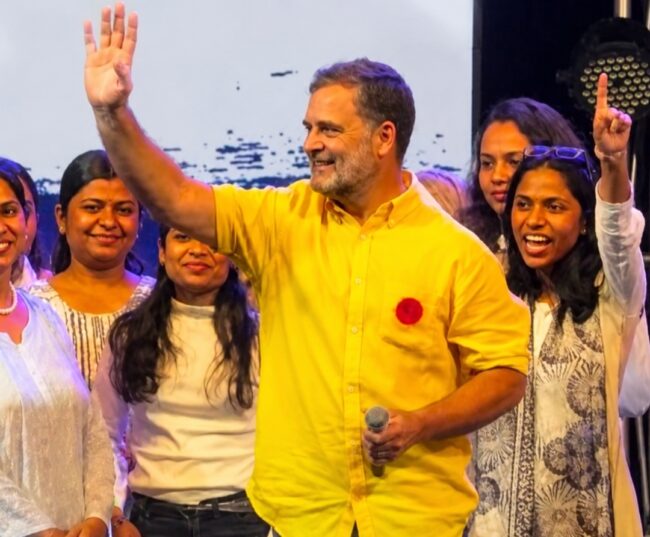
Breaking the Patriarchal Political Structure
For decades, Indian politics has largely been structured around male leadership, male-dominated political organisations and traditional power hierarchies.
The Pune gathering offered a very different picture.
Young women were not being presented merely as beneficiaries of government schemes or as an electoral constituency. They were being recognised as political voices of their own.
Breaking patriarchy is not simply about giving women representation.
It is about breaking the structures that tell women that leadership is not their natural space.
It is about creating an environment where a young woman can question a Chief Minister, challenge a Prime Minister, debate economic policy, speak about unemployment and demand justice without being told that politics is a man’s domain.
That is the deeper significance of Rahul Gandhi’s engagement with young women students.
The Media May Look Away — But India Is Watching
Interestingly, much of the mainstream media appears reluctant to acknowledge the growing political resonance of Rahul Gandhi.
There is an understandable political calculation behind this.
Acknowledging the growing acceptance of Rahul Gandhi as a credible alternative to the present BJP regime would require acknowledging something that the political establishment would rather conceal — that beneath the noise of television studios, social-media propaganda and manufactured narratives, a different political mood is developing on the ground.
But political movements are rarely created inside television studios.
They are created in universities, streets, villages, workplaces and among young people who begin to believe that change is possible.
Rahul Gandhi’s growing engagement with students and young citizens is therefore significant not because every television channel chooses to report it, but precisely because these conversations are beginning to travel beyond the traditional media ecosystem.
The more attempts are made to suppress a political idea, the more powerful that idea can become when people experience it directly.
The Obama Moment — A Parallel Worth Remembering
There are echoes here of the political transformation witnessed in the United States in 2008.
When Barack Obama emerged as the Democratic presidential candidate and subsequently won the presidency, he represented something larger than an electoral victory.

His campaign captured the vision of millions of young Americans who believed that politics could once again be about hope, participation and change.
The famous message of “Hope” and “Change” resonated particularly strongly among young voters who felt disconnected from the established political system.
India is obviously not America, and the political circumstances of the two countries are entirely different.
Yet political movements across democracies share one important characteristic: they gather momentum when a new generation begins to believe that its voice matters.
That is the parallel that deserves attention.
Rahul Gandhi’s political journey is increasingly becoming connected with a generation of Indians who want to be heard rather than instructed; who want opportunities rather than slogans; and who want a government that answers questions rather than avoids them.
A New Generation Is Beginning to Speak
The significance of the Pune all-girls interaction lies precisely in this larger transformation.
A young woman sitting across from Rahul Gandhi and speaking openly about her aspirations is not merely participating in a political programme.
She is breaking a wall.
A student demanding answers about examination failures is breaking another wall.
A young person questioning unemployment is breaking another.
A citizen asking why institutions are being weakened is breaking yet another.
Democracy advances when these walls begin to fall.
And perhaps this is why Rahul Gandhi’s politics increasingly unsettles those who have benefited from keeping these walls intact.
He is not merely asking for votes.
He is asking people to question.
He is asking students to participate.
He is asking women to lead.
He is asking young Indians to believe that political power belongs to them as much as it belongs to anyone else.
The Alternative India Is Looking For
The biggest challenge before the BJP today may therefore not be an opposition slogan or a single election campaign.
It may be the emergence of an alternative political imagination.
For years, the BJP has attempted to present itself as the only viable political force capable of governing India.
But democratic politics does not allow any party to permanently claim ownership of the future.
When people begin to see an alternative, the political equation changes.
Rahul Gandhi’s transformation from being dismissed and caricatured by his opponents to becoming a serious national political force is therefore worth examining.
The more he engages directly with students, women, farmers, workers and ordinary citizens, the more the artificial walls surrounding his political image begin to collapse.
And behind those walls, a different Rahul Gandhi is becoming visible.
Not as a politician who claims to have all the answers, but as a leader willing to listen, question and stand with those who believe that India can be different.
Hope Is Always the Beginning
The real power of a political movement is not measured only by television ratings, newspaper headlines or social-media trends.
It is measured by whether ordinary people begin to feel that their voice matters.
The young women of Pune are part of that emerging story.
They represent a generation that refuses to inherit the limitations imposed on previous generations.
And if Rahul Gandhi can continue to build that bridge between India’s young citizens and its democratic institutions, he may well become the political expression of a much larger aspiration.
Just as millions of young Americans in 2008 came together around the belief that change was possible, India too may be witnessing the early stages of a new political awakening.
The circumstances are different.
The country is different.
The challenges are different.
But the emotion is familiar.
It is the desire to believe again.
It is the courage to question.
It is the determination to break old walls.
And above all, it is the hope that the future can belong to a new generation.
That is the real significance of Rahul Gandhi’s Pune interaction with young women students — not merely another political event, but another wall of India’s old political order beginning to crack.
Adv. Mathew Antony
