
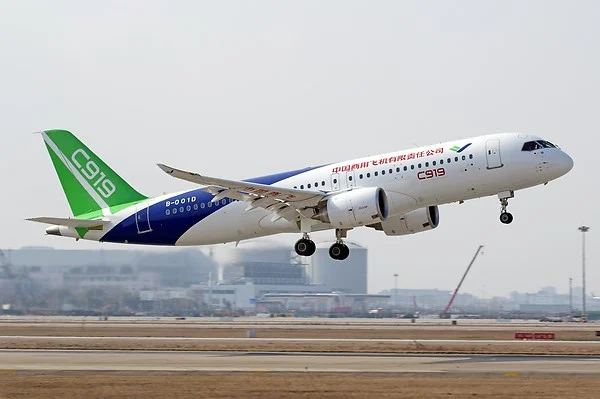
European aviation safety authorities have conducted evaluation flights of China’s C919 in Shanghai, marking an important technical step that highlights COMAC’s global ambitions as well as the careful, gradual pace of Western aircraft certification processes.
Europe Begins Flight Evaluations of China’s COMAC C919 Jet
European aviation regulators have started flight assessments of China’s COMAC C919 narrowbody jet in Shanghai, marking a quiet but important step toward potential Western certification.
The development was first reported by China’s Global Times and later confirmed by Reuters, which cited the European Union Aviation Safety Agency (EASA). The agency stated that the test flights were part of ongoing “validation activities” for the aircraft.
Sources familiar with the program said two EASA test pilots conducted verification flights from Shanghai Pudong International Airport in November, near the C919’s final assembly line. These evaluations are part of broader technical cooperation between EASA and COMAC, as China aims to position the C919 as a viable alternative to Airbus and Boeing in the global single-aisle market.
While EASA has not shared the flight outcomes, it confirmed that in-flight testing is a standard part of the certification process. Approval by EASA is necessary for European airlines—and other carriers recognizing EASA standards—to operate the aircraft.
EASA Certification: A Major Hurdle
The C919, China’s first domestically produced jet built to international airworthiness standards, entered commercial service in May 2023 with China Eastern Airlines. Since then, it has flown exclusively with Chinese carriers, aside from a limited charter in Hong Kong in 2024.
COMAC has openly expressed its ambition to sell the aircraft internationally, but Western certification has proven more complex than expected. EASA executive director Florian Guillermet previously estimated the validation process could take three to six years, suggesting approval might not arrive until 2028–2031.
This timing would place the C919 at a disadvantage, entering markets where the Airbus A320neo and Boeing 737 MAX families have operated for over a decade, and without an established global support network. Guillermet emphasized that despite the C919 using Western components like the CFM Leap-1C engine, EASA must independently evaluate the jet’s design, systems integration, and overall safety.
Although the EU–China Bilateral Aviation Safety Agreement of 2020 theoretically streamlines the process, EASA has noted that evaluating a manufacturer with little experience in certified commercial aircraft remains demanding.
Exploring African Markets
With European approval years away, COMAC is exploring markets willing to act independently. In September 2025, Nigeria’s civil aviation authority confirmed it was reviewing the C919’s certification for domestic use. If approved, this could represent COMAC’s first significant entry outside China.
Nigeria, Africa’s largest aviation market, mainly operates Airbus and Boeing jets and has never certified a modern Chinese airliner. COMAC is offering Nigerian carriers leasing packages, pilot training, maintenance support, and a potential regional spare-parts hub. Industry observers welcome the added choice but remain cautious, citing the MA60 turboprop’s past reliability issues in Africa.
Production and Supply Challenges
Despite progress in certification, COMAC faces industrial challenges. Only five C919s were delivered in 2025, well below initial targets, leading the company to scale back near-term production plans. By comparison, Airbus and Boeing each deliver over 500 single-aisle jets annually.
The program also depends on foreign suppliers, making it vulnerable to geopolitical risks. Earlier this year, US export controls briefly disrupted deliveries of CFM engines, highlighting potential supply chain fragility.
For COMAC, EASA’s flight evaluations—though preliminary—are a symbolic milestone. For regulators and international airlines, they underline that certification is a rigorous technical process, not a political gesture, and one that requires significant time and resources.
