
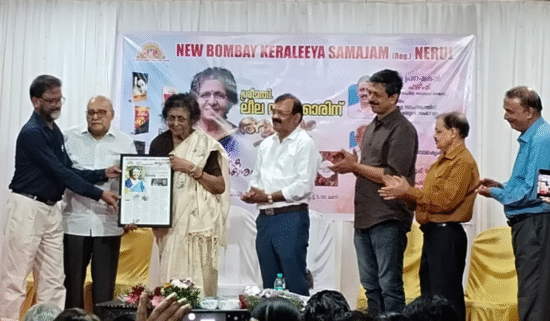
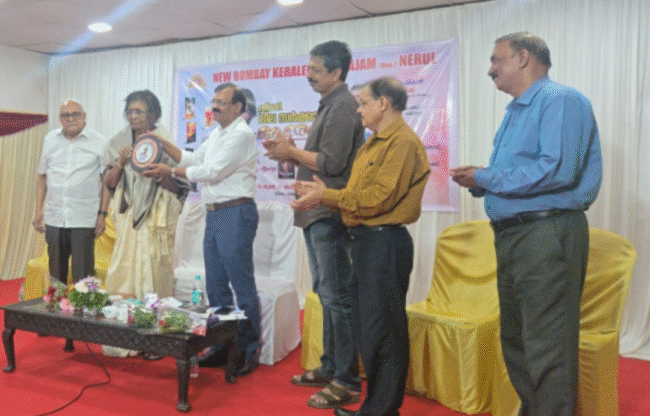
Mumbai: The New Bombay Keraliya Samajam honoured renowned translator Leela Sarkar, recipient of both the Sahitya Akademi and Kerala Sahitya Akademi awards, for introducing immortal classics of Bengali literature to Malayalam readers. The felicitation recognized her outstanding literary contribution, which includes translating more than a hundred Bengali works—including the famous detective series featuring Byomkesh Bakshi—into Malayalam, as well as translating several acclaimed Malayalam works into Bengali.
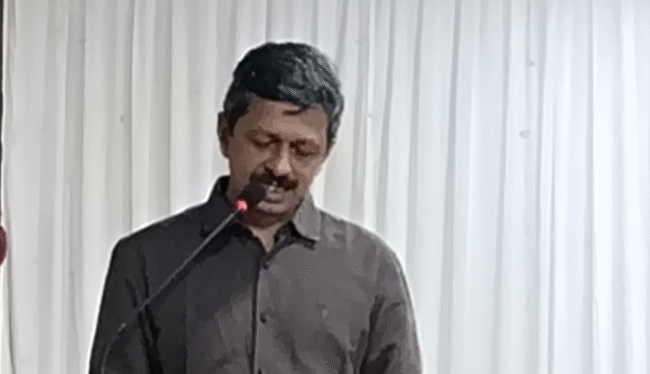
The cultural gathering, held at the Nerul Samajam Hall, was inaugurated by noted novelist Balakrishnan, who said he considered it a great privilege to participate in the felicitation of someone he regarded as a close member of his extended family.
Delivering the keynote address on “The Contribution of Translation to Malayalam Literature,” acclaimed writer S. Hareesh observed that the true spirit of Kerala and its vibrant cultural activities often flourish outside the state. He described translation as a powerful cultural force that has transformed civilizations by enabling the exchange of languages and cultures. Referring to the multilingual inscription carved in Egypt in 196 BC, he noted that the growth of major world languages, the European Renaissance, and scientific advancement were all significantly influenced by the translation of the Bible and Arabic texts across different historical periods.
He further remarked that Malayalam is perhaps the Indian language with the richest tradition of translation, as it has always remained open to influences from diverse cultures. He credited Benjamin Bailey, who transformed poetic language into prose at a time when Malayalam lacked a developed prose tradition, as a founding figure of the language, deserving recognition alongside Thunchaththu Ezhuthachan.
According to S. Hareesh, one of the greatest turning points in Malayalam translation was the rendering of Les Misérables into Malayalam by Nalappat Narayana Menon. To finance its publication, Vallathol Narayana Menon reportedly pledged his own poetry collections. Together, they helped bring the masterpiece to the people, profoundly transforming Malayalam itself. Expressions such as “red tape” and “born with a silver spoon in one’s mouth,” now common in Malayalam usage, entered the language through this translation, he recalled.
He also pointed out that the works of Leo Tolstoy, Fyodor Dostoevsky, Maxim Gorky, and One Hundred Years of Solitude had a profound influence on Malayalam writers and many of their major works. He said that writers of his generation, including himself, grew up reading Bengali translations by translators such as K. Ravivarma, Sathyarthi, and Leela Sarkar. Those translations, he added, gave tremendous strength to a new generation of Malayalam writing. He acknowledged that his own novel Pattunoolpuzhu also bears this influence and said that honouring literary figures like Leela Sarkar, who have become part of history, strengthens cultural life.
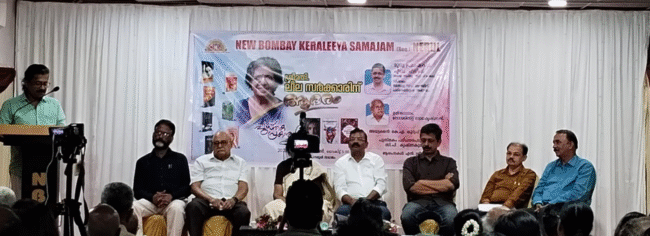
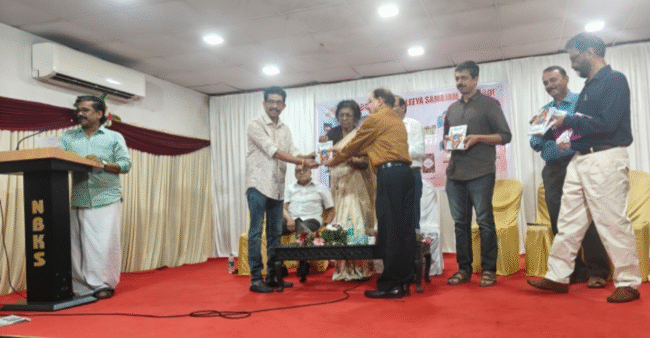
Responding to the felicitation, the nonagenarian Leela Sarkar said that although she had received numerous awards, this was the first time a Malayalam cultural organization in the land where she lives had honoured her. C. P. Krishnakumar introduced the audience to Leela Sarkar’s remarkable body of translated works and literary journey. The function also witnessed the release of three new books translated by Leela Sarkar.
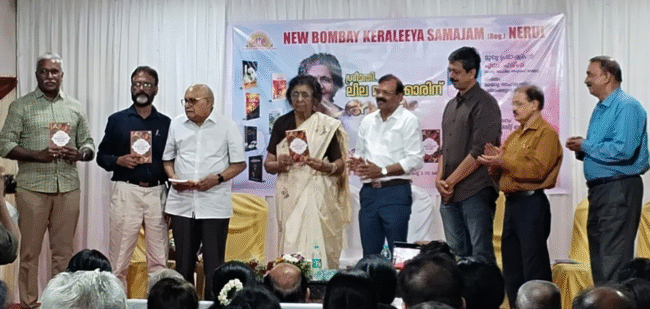
Veteran journalist N. Sreejith extended his greetings on the occasion. Welcoming the gathering, Samajam General Secretary Prakash Kattakkada announced that a special section dedicated exclusively to Leela Sarkar’s works would be established in the Samajam library.
Three newly translated books by Leela Sarkar were formally released during the event. The Malayalam translation of renowned Bengali writer Buddhadeb Guha’s celebrated work The Story of a Hunter (Oru Naayattukaarante Kadha) was presented by C. P. Krishnakumar to M.P.R. Panicker, Convenor of Aksharasandhya.
The function was presided over by Samajam President K. A. Kurup, while T. Mohanasundaran proposed the vote of thanks.
