
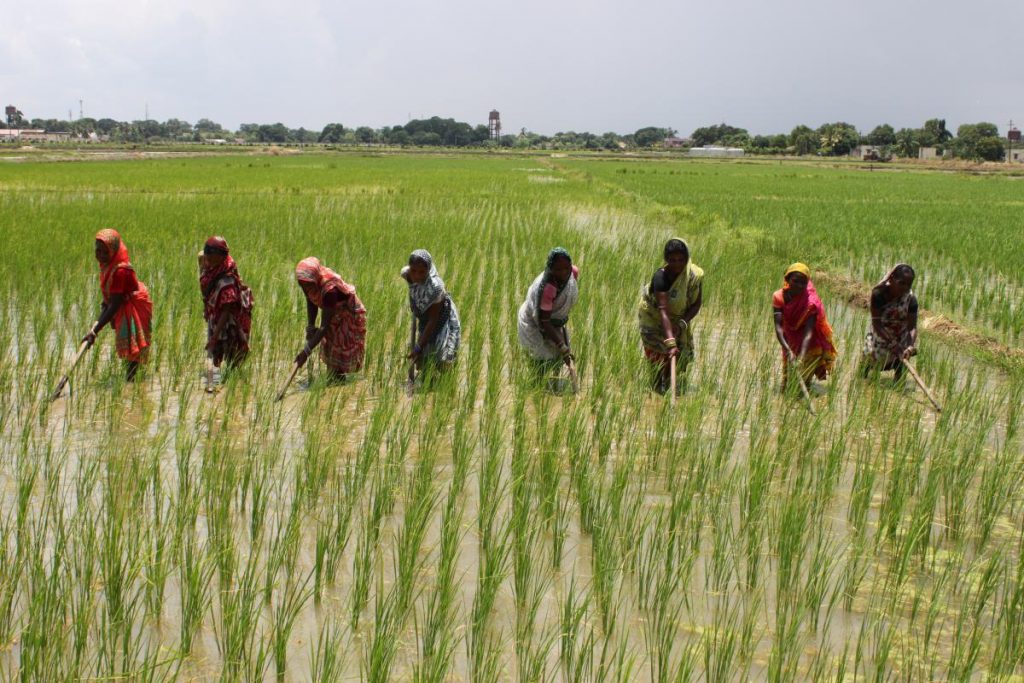
India is among the world’s largest rice producers, yet its dominance in global rice markets comes with deep-rooted challenges related to groundwater depletion, low productivity, crop diversification, and nutritional security. These concerns have intensified as rice cultivation continues to expand across water-stressed regions.
In 2024–25, India overtook China to become the world’s largest rice producer, contributing nearly 28 per cent of global output and about 40 per cent of international rice trade. Despite this achievement, the ecological and economic costs of rice-led growth have raised serious policy questions.
Water Stress and Environmental Impact
Rice is a highly water-intensive crop. Producing one kilogram of rice requires an estimated 3,000–4,000 litres of water, placing enormous pressure on groundwater resources. In several rice-growing states, excessive groundwater extraction has led to declining water tables and long-term ecological stress.
To address this, states such as Punjab and Haryana enacted the Preservation of Subsoil Water Act in 2009, restricting early paddy sowing to reduce dependence on groundwater irrigation. While this helped conserve water, it also shortened the cropping cycle and indirectly contributed to widespread stubble burning, worsening air pollution in northern India.
Historical Context of Rice Cultivation
Archaeological evidence suggests rice cultivation in the Indian subcontinent dates back to the Indus Valley civilisation. Unlike China, where rice was traditionally grown in winter, India developed both summer and winter varieties, leading to the evolution of Oryza sativa indica.
Today, India is home to nearly 60,000 rice varieties out of the estimated 1,23,000 varieties globally. Rice remains the staple food for nearly 65 per cent of India’s population and around half of the global population.
Export Patterns and Regional Dependence
Indian rice exports are dominated by non-basmati varieties, which account for about 70 per cent of export volume but less than half of export value due to lower prices. African nations and neighbouring South Asian countries primarily import non-basmati rice, while premium basmati rice is exported to the Middle East, Europe, and the United States.
India also exports broken rice to China, where it is used mainly for animal feed and ethanol production.
Food Security and Government Intervention
The National Food Security Act (NFSA), enacted in 2013, legally guarantees subsidised foodgrains to nearly two-thirds of India’s population through the public distribution system. Rice forms the backbone of this system.
For 2025–26, rice accounts for more than 65 per cent of total foodgrain allocations under welfare schemes. As of January 2026, rice stocks in the central pool stood far above the required buffer norms, ensuring short-term food security but also raising storage and fiscal concerns.
To address nutritional deficiencies, the government introduced rice fortification with iron, folic acid, and vitamin B12 through pilot projects in 2019, later scaling it up nationwide in 2022.
Productivity and Structural Constraints
India’s average rice yield remains relatively low at around 2,929 kg per hectare, significantly behind China’s yield of over 7,000 kg per hectare. Limited mechanisation, fragmented landholdings, and dependence on subsidies for water, electricity, fertilisers, and minimum support prices have constrained efficiency gains.
Experts note that these incentives have encouraged the continued dominance of rice cultivation, even in ecologically unsuitable regions.
Push for Crop Diversification
Concerns over the paddy–wheat cycle are not new. As early as 1986, a committee led by economist S S Johl recommended diversifying at least 20 per cent of Punjab’s cropped area. Later proposals called for shifting large tracts to less water-intensive crops.
More recently, state governments have introduced financial incentives to promote diversification. In 2025, Punjab launched a pilot scheme offering financial assistance to farmers shifting from paddy to maize across selected districts.
The Road to Sustainable Rice Production
Climate change and erratic monsoon patterns pose additional risks to rice production and global food markets. In 2023, India’s restriction on non-basmati rice exports due to domestic concerns led to sharp global price increases, highlighting India’s influence on international food security.
Experts argue that long-term sustainability will require greater adoption of water-saving technologies such as Direct Seeded Rice, along with stronger incentives for climate-resilient crops like millets, pulses, and maize.
While rice will remain central to India’s food system, balancing productivity, environmental sustainability, and nutritional diversity will be critical for ensuring future food security.
